
Indonesia
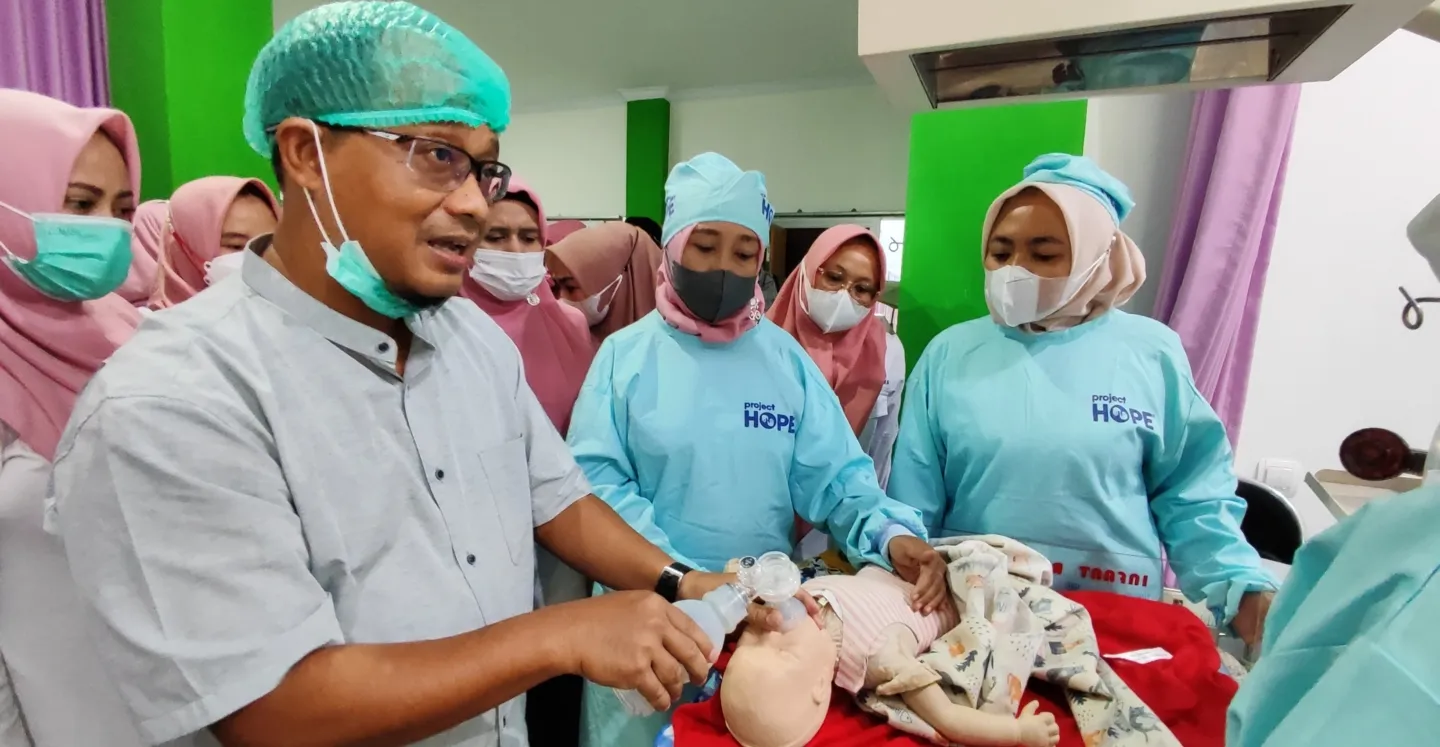
Improving access to quality health services by strengthening the capacity of local health workers
The Context
Indonesia has made significant progress in improving public health indicators over the past three decades, but challenges remain. Indonesia’s health system has a shortage of qualified health workers and many have difficulties accessing care.
Indonesia is home to some of the highest maternal and neonatal death rates in Southeast Asia, with two mothers and eight newborns dying every hour from primarily preventable causes.
Indonesia also has the second-highest tuberculosis (TB) rate in the world with around a million new cases and over 100,000 TB-related deaths each year.

1 million
new cases of tuberculosis each year
Roughly 10% of the world’s tuberculosis cases are in Indonesia.

8
newborns die every hour from preventable causes
Indonesia has some of the highest maternal and neonatal death rates in Southeast Asia.

1
hospital bed per 1,000 people in Indonesia
This is well below the world average of 3.6 per 1,000 people. There are also only 25 doctors per 100,000 people.
Our Impact
Reducing Maternal and Neonatal Mortality
The team in Indonesia is currently implementing two lifesaving maternal care programs. This work is focused on improving the availability of routine and emergency maternity care in rural areas, as well as improving infection, prevention, and control practices to improve birth outcomes and prevent complications like infections and sepsis.
From 2013 to 2025, Project HOPE implemented the Saving Lives at Births (SLAB) program to reduce maternal and neonatal mortality by supporting local health systems. We trained and equipped health workers to deliver quality antenatal, postnatal, and emergency care to high-risk mothers and newborn. Project HOPE also provided follow-up coaching with health providers to ensure skill retention. Through similar programs, Project HOPE equipped midwives and doctors with the skills and equipment necessary to detect potential birth defects during pregnancy, screen newborn babies for congenital hypothyroidism, and support mothers and families with psychological first aid.
Combatting Tuberculosis
Project HOPE previously co-led a USAID-funded consortium that developed a strategic health communication campaign to improve the coverage and outcomes of TB preventative treatment (TPT). The program leveraged high-level political and faith-based support to improve reporting, encourage the practice of safe and preventive health behaviors, and mitigate stigma.
Additionally, as part of a regional effort to integrate TB and mental health care, Project HOPE developed a collaborative care model to provide mental health support for people receiving TB treatment that included screening tools for depression, anxiety, and alcoholism; evidence-based mental health interventions; monitoring and evaluation; and research.
Infection and Prevention Control
Project HOPE worked with local health facilities to strengthen preparedness and response to COVID-19 and other infectious threats by strengthening Infection Prevention Controls (IPC). This included conducting assessments at health facilities, providing comprehensive training for frontline health workers, and capacity strengthening to monitor and manage IPC and address caps in care.
Mental Health and Psychosocial Support
Project HOPE’s Mental Health and Psychosocial Support (MHPSS) program previously equipped health workers with the training and skills needed to deliver quality MHPSS and self-help support for mothers and newborns, as well as promote mental health resilience programs for women and families.
Our History in Indonesia
Project HOPE’s history in Indonesia dates back to the S.S. HOPE’s maiden voyage in 1960 when volunteers provided medical services and training. Over the past two decades, Project HOPE has worked across all regions of Indonesia to strengthen the health system, improve health worker capabilities, and save lives.
Project HOPE has a long history of humanitarian response in the country, including the 2004 Indian Ocean tsunami, 2018 Central and West Sulawesi earthquake, 2021 East Nusa Tenggara flash flood, 2021 Semeru volcano eruption, and the 2022 Cianjur earthquake.
In 2018, Project HOPE worked to reduce asthma-related morbidity and mortality in partnership with the Indonesian Ministry of Health by training health workers, strengthening health facilities, and educating patients and families on early detection and treatment. Project HOPE then started the TB STRIDES program to improve the detection and diagnosis of multidrug- or rifampicin-resistant TB.
In 2020, we established a regional disaster and emergency response hub in Indonesia to improve our preparedness. During the COVID-19 pandemic, Project HOPE distributed personal protective equipment (PPE) and critical medical equipment to hospitals and health facilities, in addition to providing health workers with mental health and resiliency trainings.
In Indonesia, Project HOPE works through a local partner called Yayasan Project HOPE, which is independently controlled and operated.

Donate
Please give now to deliver urgent relief to people facing disasters and health crises — and make a lasting impact by rebuilding clinics, supporting health workers, providing mental health care, and more.

Join
Follow us on social media, share photos and videos of our work with your family and friends, and join our community of global health champions.

Fundraise
Whether you’re looking to host an in-person event, create your own fundraiser for your birthday, do a charity stream, or run a race, join our community of fundraisers!