Crisis in Ukraine: How To Help
Project HOPE is on the ground responding to the Ukraine crisis and is actively shipping essential medicines and medical supplies to assist Ukrainians. Learn more about this crisis and how you can help.
The situation on the ground in Ukraine is urgent. Civilians and medical workers have been killed and more than 3 million Ukrainians have fled home seeking safety.
Your support saves lives. Help us reach vulnerable children and families around the world today.
![]()
The crisis in Ukraine is spiraling into a widespread humanitarian catastrophe.
Millions of people are in urgent need both inside Ukraine and in surrounding countries. The United Nations is warning that continued conflict in Ukraine could displace 10 million people — a staggering number that would make it one of the largest refugee crises on earth. Immediate medical support is needed to prevent the country from spiraling even deeper into a humanitarian crisis that could impact tens of millions of people.
As conflict intensifies inside Ukraine, Project HOPE is on the ground actively delivering medical supplies and other urgent assistance in Ukraine and surrounding countries.
Your support saves lives. Help us reach vulnerable children and families around the world today.
![]()
How Project HOPE is Responding
>> Read our latest Situation Report on the Ukraine crisis
>> Jump to how you can help
>> What are the greatest needs in Ukraine?
March 25, 2022: Project HOPE Supplying New Ward for Ukrainian Children in Poland
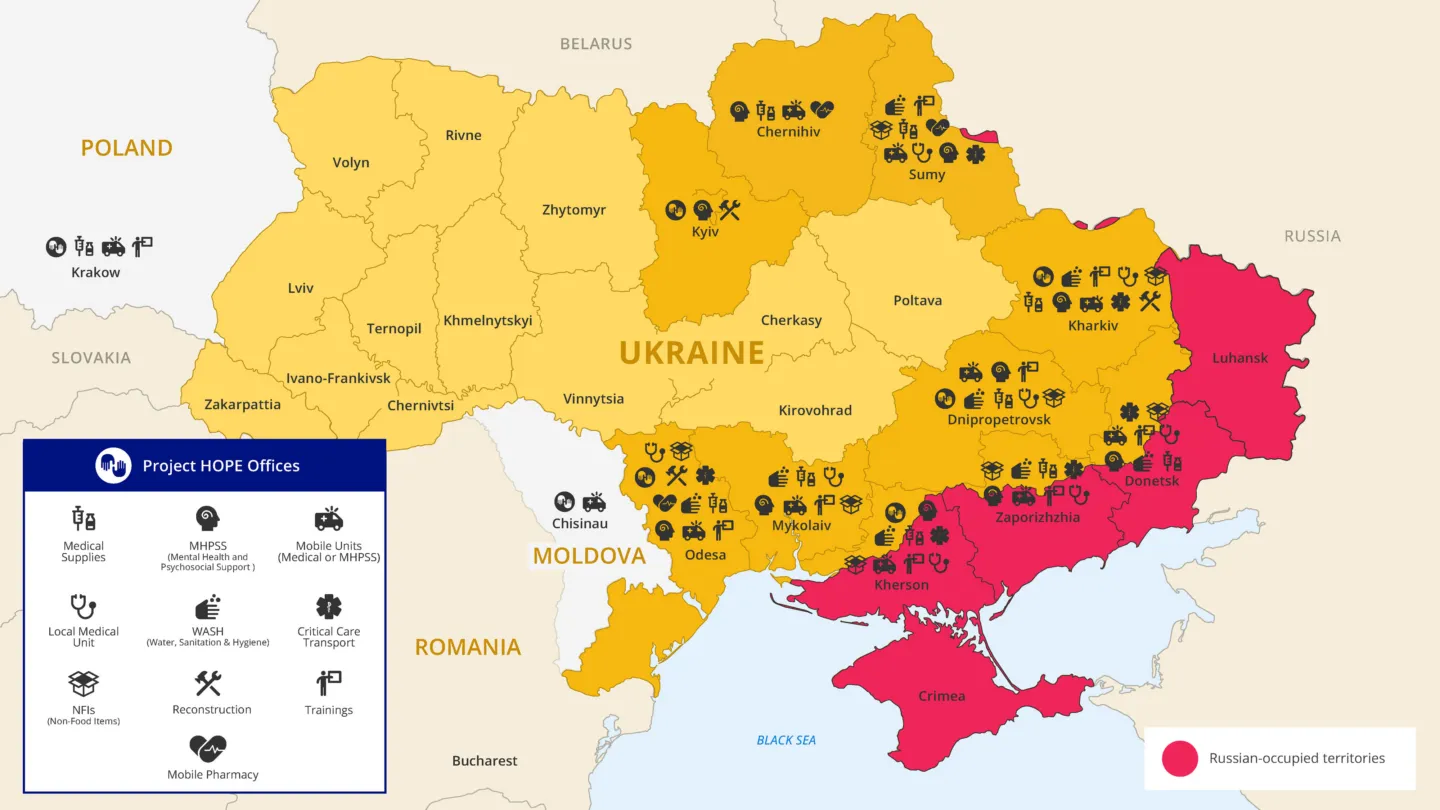
Project HOPE’s dual approach to the impact of the conflict has focused on providing support inside Ukraine through medical resupply as well as mental health and protection initiatives, as well as support to the refugee populations in Moldova, Poland, and Romania.
In Poland, we’re working with Krakow Children’s Hospital to supply a new ward for Ukrainian children, including the procurement of pharmaceuticals, medical supplies, and more. The surge of additional patients to the hospitals has necessitated additional space and personnel to serve the Ukrainian population, and Project HOPE has had an extensive, multi-decade relationship with Krakow Children’s Hospital.
Project HOPE continues to expand our partnerships and activities across the region, including working with Estuar Foundation in Romania to provide mental health training to health professionals and providing mental health consultations to Ukrainian refugees in Romania.
Read more in our full situation report here.
March 21, 2022: More Relief Arrives in Ukraine; First Shipment to Odessa This Week
Project HOPE continues to scale up our response in Moldova, Poland, Romania, and Ukraine as the violence continues and the number of refugees increases. In the last few days, Project HOPE successfully moved shipments from Poland into Ukraine and is anticipating a shipment from Moldova to be transported into Odessa this week.
We’re working with government officials in Romania to import medicines, medical supplies, and other humanitarian goods into Ukraine, and exploring multiple supply routes to get these supplies to where they need to go.
We’ve provided grants to a number of small NGOs supporting refugees in Romania and anticipate releasing more funds to NGOs in Poland this week, including for mental health and psychological first aid support. Additionally, our team in Ukraine is exploring the expansion of programming from medical resupply into psychosocial, protection, and water, sanitation, and hygiene support.
Read the full report in our latest situation report on Ukraine here.
March 18, 2022: Project HOPE Supporting Mobile Medical Units in Moldova
In Moldova, Project HOPE’s support is helping provide health care and screenings for Ukrainian refugees who have just crossed the border. Almost all refugees who are crossing are women or children, and these mobile clinics — which are staffed by SAMU, a Spanish NGO — are helping ensure that refugees have immediate health care support once they leave the country. Project HOPE has previously partnered with SAMU after emergencies like Hurricanes Eta and Iota in Honduras.


March 17, 2022: Two More Shipments of Aid Arrive in Lviv
Project HOPE’s response to the Ukraine crisis continues to expand inside and around Ukraine, including the delivery of two Interagency Health Kits into Lviv, Ukraine today. These kits will provide enough primary health care medication to provide for 20,000 people over the next three months.
Project HOPE is also facilitating the transport of five pallets of anesthesia and injectables from Krakow into Lviv this week. Additional IEHKs will be transported into Ukraine next week, as well as International Health Partner UK’s Emergency Health Packs and other supplies.
To date, Project HOPE’s support has included the delivery of essential medicines, medical equipment, and consumables as well as hygiene kits and other non-food items like towels and bedding. Project HOPE’s teams are also working with partners and developing action plans to address health, mental health and psychosocial support (MHPSS), additional non-food items, protection, and water and hygiene needs in Ukraine and among refugees.
Read more in our latest situation report here.

March 14, 2022: Project HOPE Delivers 22 Pallets of Antibiotics and Surgical Supplies to Lviv
As airstrikes draw closer to the western city of Lviv, Project HOPE delivered a large shipment of antibiotics, surgical supplies, and other medical necessities to First Emergency Territorial Hospital in Lviv this morning.


Project HOPE’s Emergency Response Team stayed at the hospital over the weekend and was also able to provide badly-needed medical supplies, including cardiac sutures that were used in a heart transplant at the hospital.
More relief for Ukraine is on the way: We are also mobilizing two Interagency Health Kits (IEHKs) to Ukraine, which are expected to arrive later this week, as well as two pallets of International Health Partner UK’s Emergency Health Packs, which are expected to arrive next week in Lviv. Project HOPE is also supporting a Ukrainian non-governmental organization so that they can purchase and transport pharmaceuticals and medical supplies to civilian hospitals throughout the country.
Project HOPE’s response continues to expand in Poland, Moldova, and Romania, including support for a mobile medical team that is treating refugee children crossing the Ukraine/Moldova border.
Read more about our response in our latest situation report here.


March 10, 2022: Project HOPE Supporting Mental Health Efforts in Romania
The number of people in need of urgent humanitarian assistance in Ukraine has quadrupled in just two weeks, with 12 million people now in need of lifesaving support. Our recent assessments in Ukraine indicate severe and worsening shortages of pharmaceuticals and medical supplies as infrastructure and supply routes are destroyed by Russian forces. Polish officials have told our team that 9 out of every 10 refugees crossing into Poland now have no contacts in the country, and three-fourths of them are from Eastern Ukraine.
Project HOPE is expanding our team in Lviv to increase our support inside the country, in addition to our teams on the ground in Moldova, Poland, and Romania. Our second shipment of medical supplies to Ukraine is expected to arrive at a children’s hospital in Lviv this week.
In Moldova, we are supporting a mobile medical team to serve refugees crossing the border at the request of the WHO and the Moldovan Ministry of Health. We’re also procuring and delivering key non-food items like blankets, bedding, and towels for refugees.
In Romania, Project HOPE is supporting local NGOs to provide mental health support to refugees, as well as hygiene and shelter needs. We’re also sourcing hygiene kits, medical supplies, and medicines for refugees as well as those inside Ukraine.
Read our latest situation report on the crisis here.
March 9, 2022: Second Shipment of Medical Supplies Being Delivered to Ukraine
Project HOPE’s response to the Ukraine crisis continues to expand across the region, including a second shipment of medical supplies that is being delivered this week to a neonatal hospital in Kyiv. Meanwhile, Project HOPE is also expanding the capacity for a Ukranian non-governmental organization in Kyiv to purchase and transport medicines and medical supplies to civilian hospitals in the country. We continue to assess health needs across Ukraine, including in Lviv and Kyiv, and are working to establish transit routes to get medicines and medical supplies in.
In Moldova, Project HOPE is procuring and delivering key medical supplies to the Ministry of Health to serve refugees. These supplies include an Interagency Emergency Health Kit (IEHK), hygiene kits, and Non-Food Items (NFIs). Our team is also assessing needs and contingency planning for health facilities in Poland as refugee numbers increase demand on the Polish health system.
In Romania, Project HOPE is identifying local partners for Mental Health and Sexual Gender-Based Violence support for refugees. We are also sourcing hygiene kits, medical supplies, and medicines for transport into Ukraine as well as for the refugee population. Our team is also establishing a relationship with a key partner to send supplies into Odessa.
Project HOPE will continue to closely monitor the situation as it unfolds in order to respond to the most pressing health and humanitarian needs among affected populations.
You can read our latest situation report here.
March 4, 2022: Medical Supplies Being Delivered to Neonatal Hospital in Kyiv


Project HOPE continues to coordinate with local NGOs, hospitals, and government officials across Poland, Romania, Moldova, and Ukraine, as well as the WHO Health and Logistics Clusters, Ministries of Health, and other authorities.
In Poland, Project HOPE is procuring key medical supplies to be delivered to a neonatal hospital in Kyiv through a local Polish partner. Project HOPE is supporting a non-governmental organization in Kyiv to purchase and transport medicines and medical supplies to civilian hospitals. We continue to assess health needs in the Dnipro region, including for those who are internally displaced.
In Moldova, Project HOPE is procuring and delivering key medical supplies to the Ministry of Health to serve refugees. This support includes an Interagency Emergency Health Kit that can support 10,000 people. In Romania, Project HOPE is sourcing hygiene kits, medical supplies, and medicines for transport into Ukraine as well as for the refugee population.
Project HOPE will continue to closely monitor the situation as it unfolds in order to respond to the most pressing health and humanitarian needs among affected populations.
Learn more in our newest situation report here.
March 2, 2022: Project HOPE Emergency Response Teams at Ukraine Border
As the number of Ukrainian refugees exceeds 1 million, Project HOPE emergency response teams remain on the ground in Poland, Romania, and Moldova to coordinate with local organizations in and around Ukraine to support Ukrainians during the ongoing crisis.
Our immediate focus is on continuing to source and ship essential medicines and medical supplies for primary health and trauma care to affected areas, including hygiene kits, Interagency Emergency Health Kits (IEHKs), insulin, and more.
“The people we are meeting in Poland — teachers, doctors, civil servants, and business owners — have had their entire lives upended by this invasion,” said Project HOPE’s Vlatko Uzevski. “These refugees have no idea when they will be able to return home or what home they will return to. Many of them only have the few belongings they were able to grab before fleeing. Within these waves of refugees are untold thousands who are pregnant, nursing, elderly, or managing serious medical conditions. The doctors and medicines they rely on are gone. There were already 3 million people in Ukraine in need of humanitarian assistance before this invasion. They are the ones who will bear the brunt of this war.”


A heartwarming story from the ground in #Ukraine, shared by our Director of Emergency Response & Preparedness. These are the moments that remind us of the humanity we all share and must preserve. https://t.co/hTJGBoXmaf
— Project HOPE (@projecthopeorg) March 3, 2022
February 28, 2022: Project HOPE Is on the Ground in Ukraine and Surrounding Countries
Project HOPE is working with the WHO Health Cluster and Logistics Cluster as well as the Ukrainian Ministry of Health and other authorities.
Our teams are focused on continuing to source and ship essential medicines and medical supplies for primary health and trauma care to affected areas, including hygiene kits, Interagency Emergency Health Kits (IEHKs), insulin, and more. We are also continuing to expand our presence within the region to provide immediate health and humanitarian relief.
@projecthopeorg is aggressively responding to the crisis in Ukraine. Our teams are working in 3 countries to support health needs of incoming refugees, with plans to expand as much as needed. I am en route to Romania to join colleagues’ efforts.
— Tom Cotter (@TomCotterER) February 28, 2022
Read our latest situation report on the Ukraine crisis here.
February 26, 2022: What is an IEHK?
Project HOPE’s initial response to the Ukraine crisis involves more than two tons of essential medicines and medical supplies that are being actively shipped to affected areas. These kits, known as Interagency Emergency Health Kits, are critical tools to help support clinics and health systems in an emergency, and each one can support 10,000 people for three months. So what is actually in them?

Some of the medicines included in the kit include amoxicillin, paracetamol, tetracycline, iodine, and oral rehydration salts. Each kit also includes medical supplies like tape, gauze, gloves, buckets, instrument trays, scissors, soap, surgical scrub brushes, and jerry cans.
IEHKs are critical tools to provide basic and primary health care in areas where there is no access to health facilities. The two kits that are included in Project HOPE’s initial shipment will be able to help meet the immediate medical needs of tens of thousands of people over the coming months.
February 24, 2022: Project HOPE Mobilizing Health and Humanitarian Assistance to Ukraine Crisis
- Project HOPE is actively shipping essential medicines and medical supplies to affected areas. We are currently readying an initial shipment of two tons of essential medicines and medical supplies to ship within the next 48 hours. These Interagency Emergency Health Kits (IEHKs) are designed to meet the initial primary health care needs of displaced populations in areas where there is no access to medical facilities. Initial medicines and equipment being shipped include oral medicines, topical medicines, medical supplies, and medical devices. These initial kits will provide enough medical supplies to care for tens of thousands of people over the coming months.
- Project HOPE is activating an emergency response team to provide immediate health and humanitarian relief. Additionally, we have medical teams on standby to provide health screenings and care for Ukrainian refugees and those inside the country who do not have the ability to flee to safety.
“What was a severe humanitarian crisis before has now become exponentially worse,” said Chris Skopec, Executive Vice President of Global Health at Project HOPE. “Today, the people of Ukraine face one of the greatest threats to their freedom and security since re-establishing statehood in 1991. Project HOPE stands by the people of Ukraine. We are actively providing medicines and medical supplies and have medical teams on standby to provide health screenings and care for Ukrainian refugees and for those inside Ukraine without the ways and means to flee to safety.”
Project HOPE will continue to closely monitor the situation as it unfolds in order to respond to the most pressing health and humanitarian needs among affected populations.
![]()
Crisis in Ukraine: What You Need To Know
The latest:
- More than 3 million refugees have fled the Russian military incursion in Ukraine, including large crowds of women and children
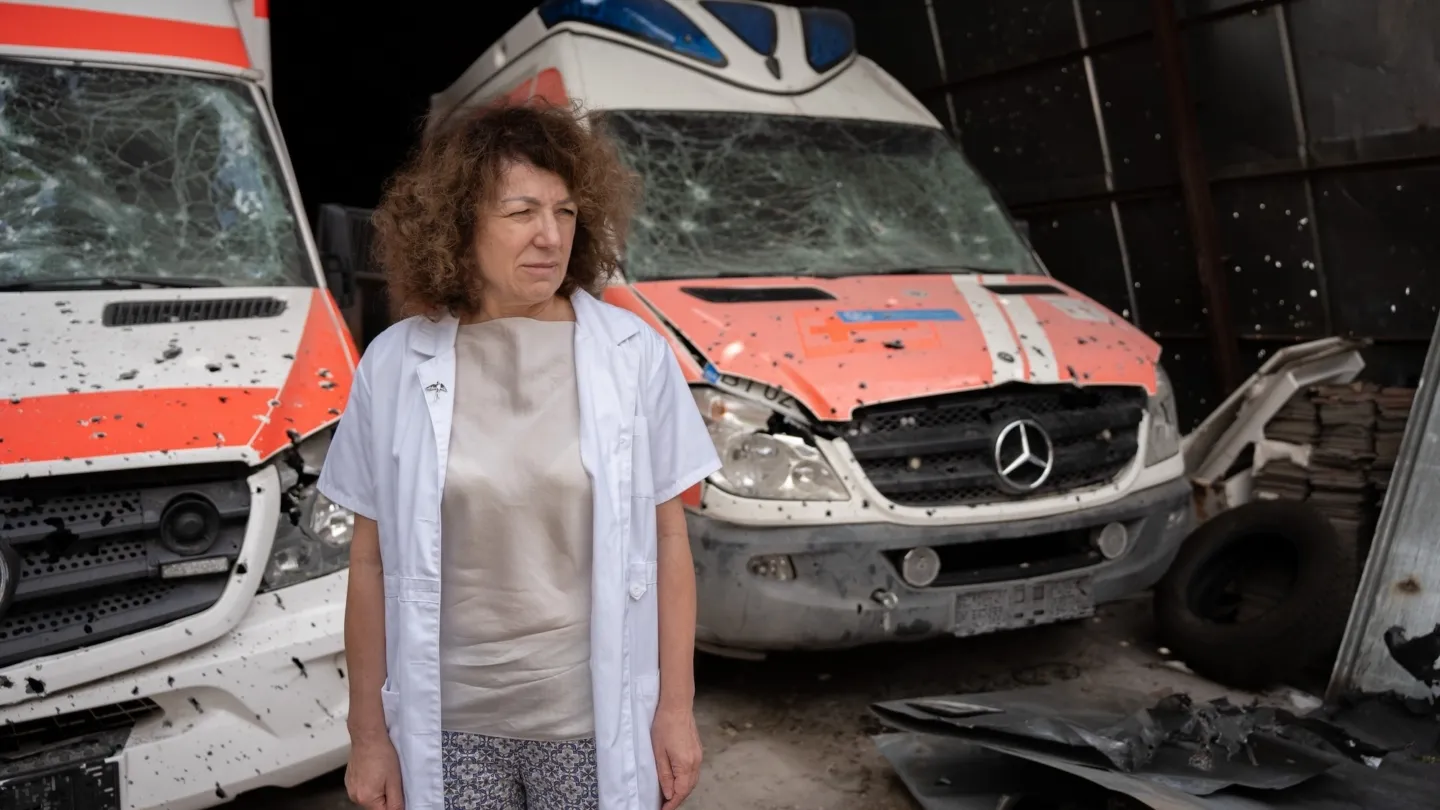
- Civilian and medical worker deaths have been reported in Ukraine, and hospitals have been hit
- Many hospitals and pharmacies in Kyiv are empty and the broader region is bracing for millions more refugees
- Project HOPE is on the ground and coordinating with local organizations in Ukraine, Poland, Moldova, and Romania to provide support inside Ukraine as well as in the surrounding countries
>> Jump to how you can help
>> Read our latest Situation Report on the Ukraine crisis
What is happening in Ukraine?
Conflict has broken out across Ukraine after a Russian military incursion began in the country early on the morning of February 24. Civilians and medical workers have been killed and more than 3 million Ukrainians have fled home seeking safety — a number that is sure to grow. The UN is warning that Russia’s invasion into Ukraine could lead to a massive refugee crisis and widespread medical needs across Europe.
Kyiv’s mayor has said that the city is at the “border of a humanitarian catastrophe,” and that the infrastructure to deliver food and medicine has been destroyed. Pharmacies and stores in Kyiv are empty, and hospitals and health facilities have reported serious shortages of medical supplies. Russia’s incursion has already prompted massive displacement, with large waves of refugees already entering neighboring countries and more to come. Ukrainians near the conflict zones are lining up to access cash and fuel, and citizens are preparing for significant disruptions to supply chains, health care, and road access.

Where is Ukraine?
Ukraine is in eastern Europe and is the second-largest country in Europe after Russia. Ukraine borders Moldova, Romania, Hungary, Slovakia, Poland, Belarus, Russia, the Black Sea, and the Sea of Azov. Ukraine was a part of the former Soviet Union and only gained full independence with the dissolution of the U.S.S.R. in 1991.
Ukraine has been divided among regional and ethnic lines since its independence and has experienced multiple conflicts. The Russian annexation of Crimea in 2014 and the ongoing Donbas War in eastern Ukraine have led to an ongoing humanitarian crisis that has impacted some 3 million people. More than 10,000 civilians had been killed or injured and 1.4 million people internally displaced before the 2022 Russian invasion began.

What are the greatest needs in Ukraine?
The impact of fighting on lives and livelihoods has been staggering. More than 3 million Ukrainians have fled since the invasion in late February. Project HOPE’s medical director in Ukraine has described a “biblical-scale exodus from East to West.” The United Nations has predicted that 10 million Ukrainians – approximately one-quarter of the population – could be displaced by the conflict.
As Project HOPE has noted in our border assessments in Romania, Poland, and Moldova, most refugees exiting the country and women, children, and some elderly residents. Our teams are seeing significant strains on host countries, especially Moldova and Poland.
Inside the country, recent assessments indicate severe and worsening shortages of pharmaceuticals and medical supplies as infrastructure and supply routes are destroyed by Russian forces. Pharmacies in Kyiv are completely empty and there are widespread shortages of medicines and food. Hospitals and health facilities are reporting serious shortages of medicines and medical supplies, including trauma supplies.
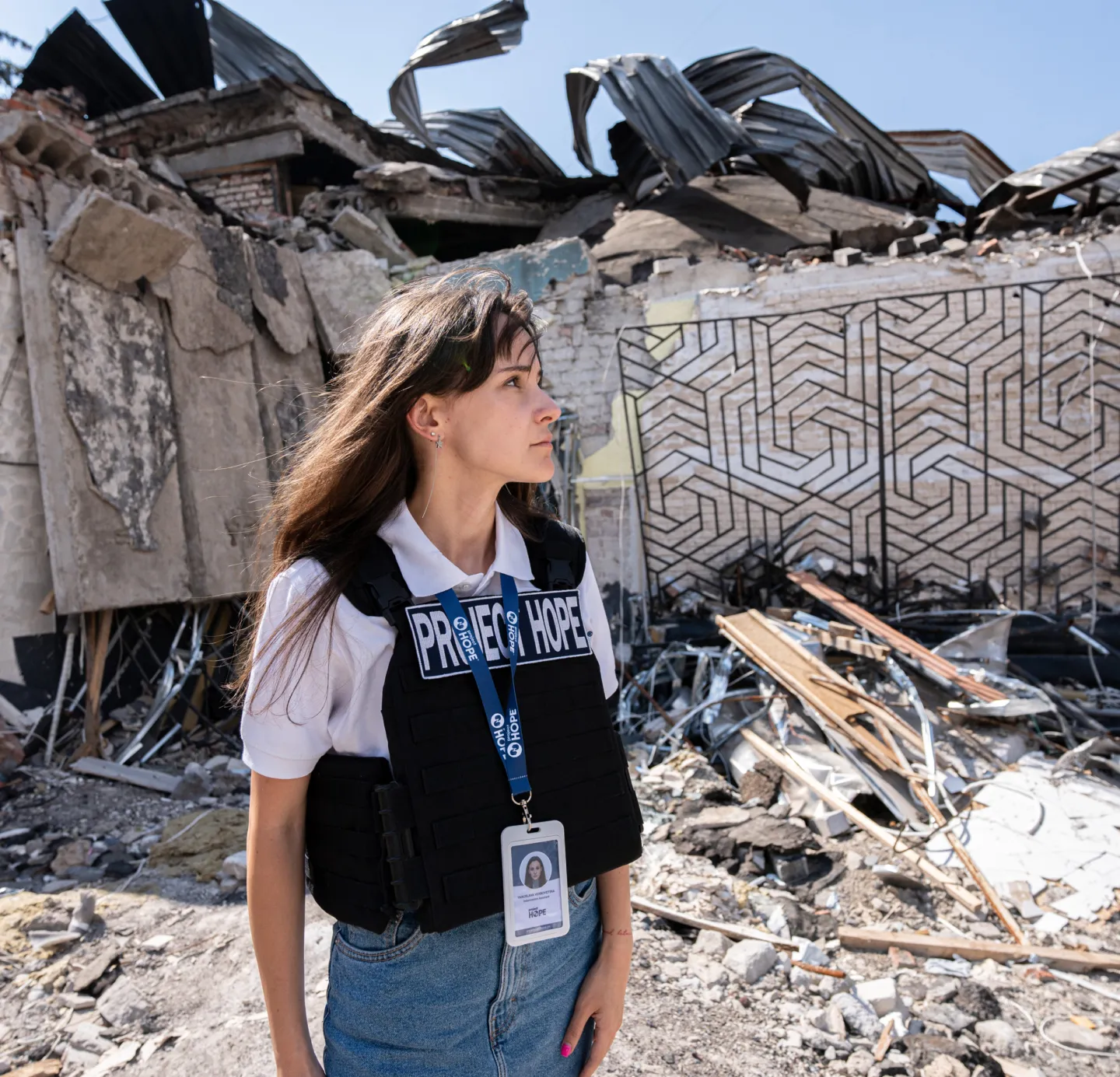
Extensive damage to infrastructure—from schools and hospitals to gas and electricity lines—means those unable to leave have limited access to essential goods and services. In besieged cities, like Mariupol, relief organizations fear that death due to dehydration, hunger, and access to medicines is becoming a growing possibility for inhabitants.
Prior to the conflict, Russian and Ukraine supplied 30% of wheat and 20% of corn on the global markets. The Food and Agriculture Organization of the United Nations and World Food Programme project that prolonged hostilities between the countries may spurn rises in global food prices. Such a development is even more worrisome considering that the Nutrition Cluster estimates that more than 2 million Ukrainian children under 5 and pregnant and breastfeeding women are in need of life-saving nutrition assistance.
> PRESS RELEASE: Crisis in Ukraine Could Spiral Into Widespread Humanitarian Catastrophe

Project HOPE’s History in Ukraine
Project HOPE began working in Ukraine in 2002 with a life-skills program focused on drug use prevention, HIV prevention, and education for children in primary schools. In 2007, Project HOPE began a five-year, USAID-funded HIV/AIDS Service Capacity project in Ukraine focused on community mobilization for the country’s most at-risk populations.
From 2012-2017, Project HOPE helped improve the health of Ukrainians by enabling the Government of Ukraine to decrease the burden of TB and lower TB morbidity and mortality.
Project HOPE has a deep history of responding to humanitarian crises around the world, including the Venezuela crisis and recent Ethiopia conflict.
![]()
How you can help Ukraine
The war in Ukraine could displace millions of people and lead to a humanitarian catastrophe that impacts vulnerable women, children, and families. If you want to help, here’s how you can get involved:
1. Make a lifesaving gift to support our work now and for the future. Project HOPE stands ready to assist the Ukrainian people with health and humanitarian aid, both in Ukraine and in surrounding countries. Our emergency response team and European partners are sending critically needed medical supplies, and they are prepared to assist refugees with health screenings, mental health support, and medical care as the crisis unfolds. Please join our efforts by making a lifesaving gift to our Ukraine crisis response today.
2. Fundraise for Ukraine by streaming on Tiltify to raise money for Project HOPE. If you’re a content creator, you can start a charity stream on Tiltify to Stream for HOPE and raise funds for Project HOPE’s mission. Tag us on social @projectHOPEorg to let us know about your charity stream so we can thank you!
3. Interested in an employee giving campaign for Ukraine? Please contact us – we are happy to help.
4. Stay up-to-date on this story and our lifesaving work around the world by following us on Facebook, Instagram, LinkedIn, and Twitter, and help spread the word about our response.